
Is Your Roof Ready for This Winter's El Niño?

There's a storm season coming, and this time, the forecasters aren't hedging. Climate researchers tracking this year's El Niño are calling it one of the strongest on record — with some models putting the odds of an above-average rain season at 70 to 100 percent, and a real chance that this winter lands among the wettest California has ever recorded.
For most homeowners, that news lives somewhere in the back of their mind until the first storm actually hits. And by then, it's often too late to do anything but respond.
The Fear: What a Wet Winter Actually Does to a Roof
Water doesn't need a dramatic opening to get into a home. It needs time, and it needs repetition — exactly what a heavy, back-to-back storm season provides. A small gap in flashing, a slightly lifted shingle, a seal that's a season past its prime — none of these show up as a problem on a dry day. They show up three storms into a wet winter, usually as a stain on a ceiling, a musty smell in an attic, or a soft spot near a vent that's already been leaking longer than anyone realized.
Strong El Niño winters on the Central Coast also tend to mean more rainy days packed closer together, with less dry time in between for a roof — or a homeowner — to catch a small issue before the next storm arrives. That compounding effect is what turns a minor, fixable issue into a much bigger one.

The Facts
Here's what's actually driving this season's concern:
Forecasters are describing this El Niño as potentially one of the largest events in the historical record.
Current models show a high probability — in the 70 to 100 percent range — of above-average winter precipitation across California.
Some forecasts put this winter among the top 20 percent of wettest California winters ever tracked.
Strong El Niño winters have historically brought more rainy days overall, with less recovery time between storms than a typical year.
None of this means panic is the right response. It means preparation is worth more this year than most.
Where the Roof Meets the Rest of the House
A roof doesn't work alone. Flashing, valleys, vents, and gutters all have to function together to move water off the house and away from the foundation. A roof that's in great shape but sitting behind a clogged, undersized, or poorly pitched gutter system is still vulnerable — the water just finds a different way to cause a problem, whether that's at the fascia, the siding, or the foundation itself.
That's part of why RCI treats gutters and roofing as one connected system rather than two separate services. A strong roof deserves a gutter system that can actually keep up with it.
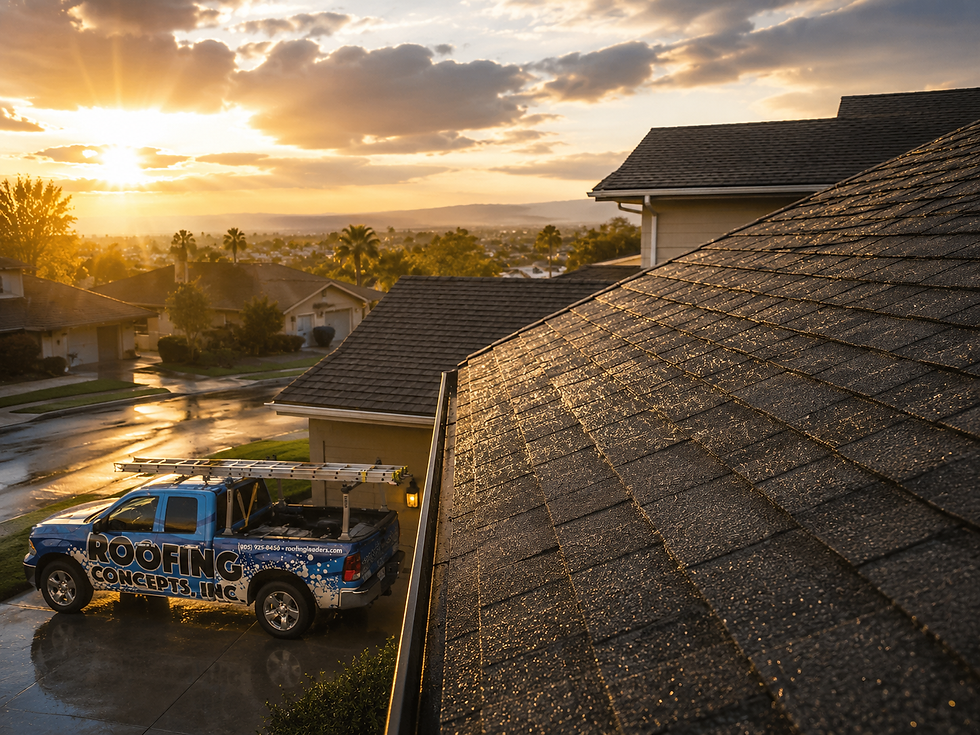
The First Line of Defense
Twenty-six years on the Central Coast has taught RCI one thing above all: the homes that come through a heavy winter the best are the ones where someone looked at the roof before the season started, not after the ceiling stain appeared. GAF-certified and built on a reputation for doing the quiet, unglamorous work of keeping roofs ready, RCI has spent over two decades being the crew that Central Coast homeowners call before the storm — not just after.
Your roof is your first line of defense. This is the season to make sure it's ready to hold that line.
CSLB #899633 · roofingconceptspro.com Proudly serving Santa Maria, Orcutt, Lompoc, Vandenberg Village, Solvang, Buellton, Santa Ynez, Los Alamos, Guadalupe, Nipomo, Arroyo Grande, Grover Beach, Pismo Beach, Shell Beach, Oceano, San Luis Obispo, Los Osos, Morro Bay, Cayucos, Cambria, Atascadero, Templeton, Paso Robles


Comments